
If you’re running local SEO — for your own business or for clients — you’re almost certainly using a rank tracker. You enter a keyword, get a position number, watch it move up or down week to week.
That number is real. The question is whether it’s the right number to be watching. For Google Maps rankings specifically, traditional rank tracking and geo-grid rank tracking are measuring fundamentally different things. One of them is far more useful — and it’s probably not the one you’ve been relying on.
How Traditional Rank Tracking Works
A traditional rank tracker checks your keyword position from a fixed location — usually a city centre coordinate or a server with a set IP address — and returns a single number. That’s your ranking.
For standard organic search results, this approach is broadly reliable. Google’s organic rankings are relatively consistent across a metro area. Whether someone searches from the north or south of a city, the top organic results tend to be similar.
So for broad SEO work — tracking a website’s position for informational or commercial keywords — single-point tracking is adequate. It gives you directional data. It tells you if things are improving or getting worse.
Why It Falls Short for Google Maps
Google Maps operates on a different ranking logic. Physical proximity between the searcher and the business is one of the heaviest ranking signals. Rankings shift — sometimes dramatically — based on where the search originates.
When a rank tracker checks from one fixed point, it captures one version of that shifting reality. The result looks like a definitive ranking. In practice it’s a snapshot of how you rank for one person standing in one spot.
Your potential customers are not standing in one spot. They’re searching from home, from work, from the car, from wherever they happen to be when the need arises. Traditional rank tracking misses all of that variation and collapses it into a single figure.
DentPlus in London scored 66/100 on our Visibility Score — Core-Strong overall. Their standard rank tracker likely showed a healthy position for ‘dentist in London’ from the city centre. The geo-grid revealed a clear weak spot in Southwark. People searching from that area were finding competitors instead. No single-point tracker was going to surface that.
How a Geo-Grid Rank Tracker Works
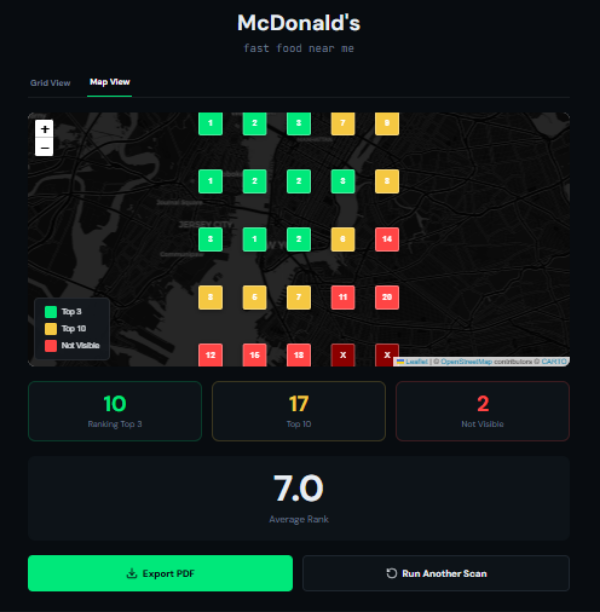
A geo-grid rank checker checks your Google Maps position from multiple points across a geographic area simultaneously. GeoRankLand uses a 5×5 grid — 25 points arranged around your business location — covering the surrounding area in all directions.
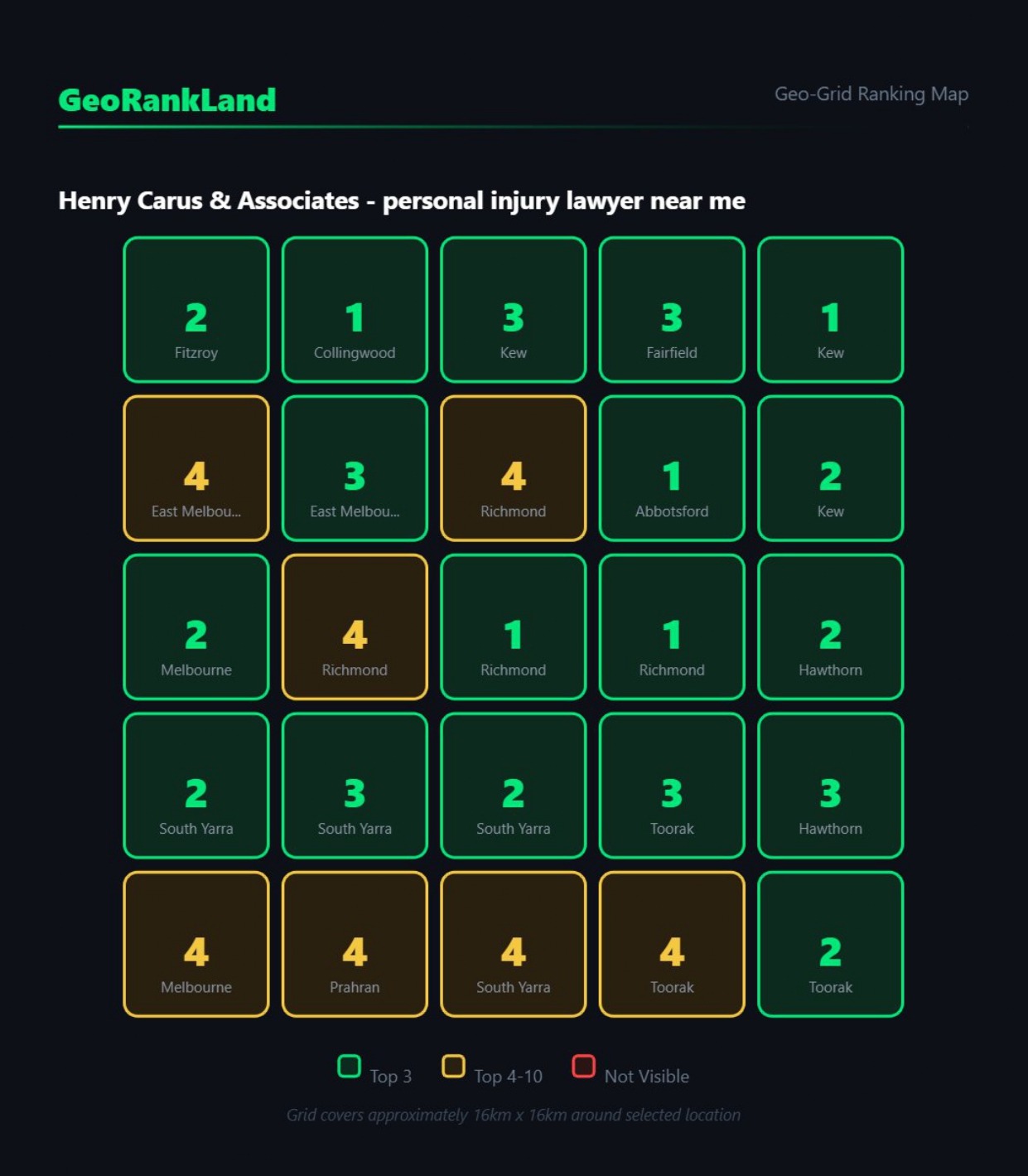
Each point is a separate ranking check at a separate physical coordinate. The result is not one number but a map: where you rank #1-3 (strong), where you hold #4-10 (moderate), and where you don’t appear at all (invisible).
From that grid, GeoRankLand calculates a Visibility Score from 0-100. Top-3 rankings are weighted more heavily than #4-10. It’s a single summary number — but one that reflects real geographic coverage rather than one optimistic data point.
The Practical Difference in Decision-Making
Here’s where the local rank tracking comparison becomes concrete. Both tools might tell you things are going reasonably well. Only one of them tells you why you’re losing customers in the next suburb.
With traditional tracking: your keyword moves from #4 to #3. You take that as a positive signal. You continue what you’re doing. Meanwhile, you’re invisible in three suburbs to the north where a competitor is consistently outranking you.
With geo-grid tracking: you see the same overall strength at the centre, but you also see the northern gap clearly on the heatmap. You know exactly where the problem is. You can investigate the competitor winning those grid points, understand what they have that you don’t, and make targeted decisions rather than broad ones.
Henry Carus & Associates, a Melbourne law firm, scored 86/100 — Local Dominant. Strong result. But the grid showed Prahran and East Melbourne as weak spots. Two high-value suburbs with strong demand for personal injury legal services, consistently going to competitors. Their traditional rank tracker was showing a healthy overall position. The geo-grid showed where money was being left behind.
What Each Tool Is Actually Good For
This isn’t about dismissing traditional rank tracking entirely. It still has legitimate uses:
- Tracking organic website rankings for content and on-page SEO
- Monitoring competitor organic positions for non-local keywords
- Broad trend reporting across a large portfolio of keywords
For those use cases, single-point tracking is fine.
But for any business that depends on Google Maps visibility — any service business where local proximity drives customer decisions — geo-grid tracking is the more accurate measurement. It’s not an upgrade on traditional tracking. It’s a different measurement entirely, built for a different ranking system.
For Agencies: What This Changes in Client Reporting
The practical difference in client conversations is significant. A graph showing a keyword position moving from 5 to 4 requires explanation and context. A heatmap showing a business lit up green across its core area with a clear red gap to the north is immediately understandable to someone with no SEO knowledge.
It also makes the problem — and the opportunity — much more concrete. Instead of ‘we need to improve your local SEO,’ you’re saying ‘you’re invisible in these three suburbs, here’s what the business winning there has that you don’t, and here’s the plan to take those grid points back.’ That’s a different quality of conversation.
Geo-grid results are also strong prospecting tools. Run a scan on a potential client before the first meeting. Show them their grid. It’s usually the first time anyone has shown them a geographic picture of their Google Maps coverage — and it’s often the moment they understand why their phone isn’t ringing as much as it should.
Which Should You Use?
If you’re tracking Google Maps performance for local businesses, the geo-grid gives you the data that actually reflects how customers find — or don’t find — those businesses. Traditional tracking gives you a simplified proxy that smooths over the geographic variation that matters most.
Use both if you’re running comprehensive SEO campaigns. Use geo-grid as your primary measurement for anything Maps-related.
Run a free scan at georankland.com — no account required to see your results.