
Most dental practices assume their Google Maps ranking is either good or bad. The data says something more useful: it’s good in some places and invisible in others — and without knowing which is which, you’re optimising blind.
This is a breakdown of a geo-grid scan we ran on a Manchester dental practice searching for “dentist near me.” We’re not naming the practice. What we are doing is walking through every data point — the good, the weak, the counterintuitive — because the pattern this scan shows is one we see repeated across dental practices in competitive UK cities.
If you’re a dentist managing your own Google presence, or an SEO manager handling a dental client, this is what your data probably looks like — and what to do about it.
What a Geo-Grid Scan Actually Measures
Before the data, a quick explanation of method — because it changes how you read everything that follows.
A standard rank checker picks one location — usually your practice address — and tells you where you appear in Google Maps from that single point. That number is real. It’s just not representative of how patients actually search.
A patient sitting in Castlefield searching “dentist near me” sees different results than a patient in Cheetham Hill doing the same search 3 kilometres away. Google’s local algorithm weights proximity heavily, which means your ranking shifts — sometimes dramatically — based on where the searcher is standing.
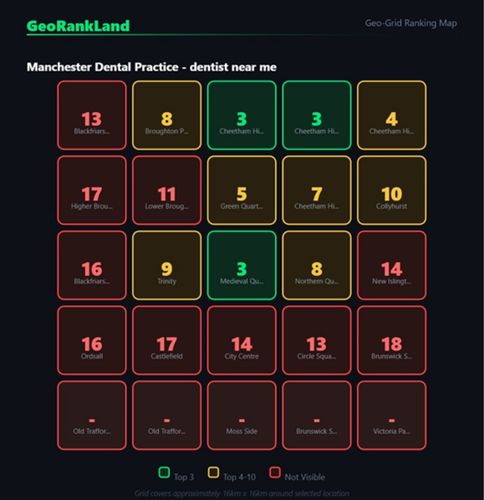
A geo-grid scan measures your Google Maps ranking from 25 points across your service area simultaneously. Each point is a real geographic location. The result is a heatmap showing where you appear in the top 3, where you appear in positions 4 through 10, and where you’re effectively invisible.
GeoRankLand ran this scan for “dentist near me” centred on a practice in Manchester’s Medieval Quarter. Here’s what came back.
The Headline Numbers
Visibility Score: 26/100 — Weak Outer Zones
Average Rank: 10.4
Grid breakdown:
- Top 3 rankings: 3 of 25 grid points
- Positions 4–10: 7 of 25 grid points
- Ranked 11–20: 10 of 25 grid points
- Not visible (outside top 20): 5 of 25 grid points
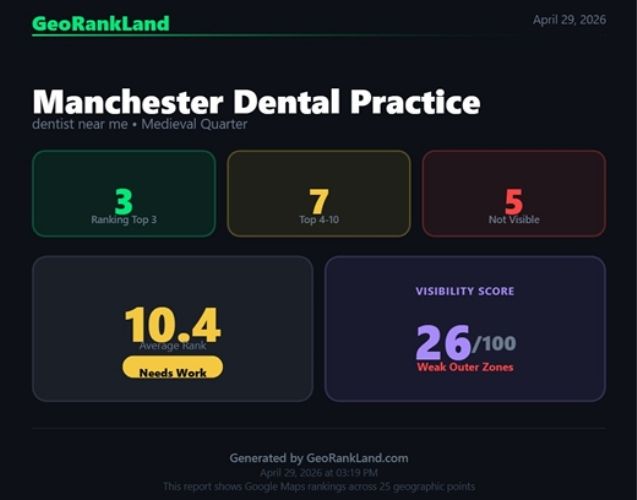
The Visibility Score is a weighted metric — top 3 positions are worth 4 points each, positions 4–10 are worth 2 points each, out of a maximum of 100. It gives you a single number that reflects geographic reach, not just average rank.
A score of 26/100 with an average rank of 10.4 tells you this practice is technically showing up across most of its area — but rarely in a position that drives clicks. Position 10 in Google Maps is the bottom of the local pack. Most patients don’t scroll that far.
The 5 completely invisible grid points — where this practice doesn’t appear in the top 20 for “dentist near me” — are in Old Trafford, Moss Side, Brunswick SE, and Victoria Park. These are full coverage blackouts.
The Finding That Changes Everything
Here’s the data point that every dental practice owner and local SEO manager needs to understand — because it flips the conventional assumption about local rankings.
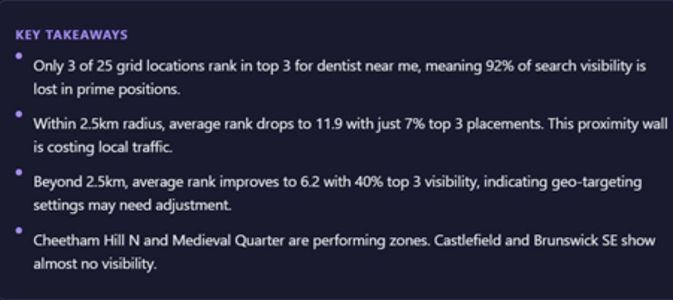
Within 2.5km of the practice address, the average rank was 11.9. Only 7% of those nearby grid points showed a top 3 ranking.
Beyond 2.5km, the average rank improved to 6.2. Top 3 visibility jumped to 40% at greater distances.
Read that again. This practice ranks significantly better from further away than from its immediate vicinity.
This is what we call a proximity wall — the point at which your Google Maps rankings deteriorate sharply as distance decreases. For most local businesses, the proximity wall sits at the outer edge of their service area. Rankings weaken with distance. Here, it’s inverted: the nearby area is where the weakness lives.
This matters enormously for a dental practice. A patient in Blackfriars — less than a kilometre from this practice’s front door — searches “dentist near me” and sees this practice at position 13. A patient in Cheetham Hill, further away, sees it at position 3.
The patients closest to the practice are the least likely to find it through Google Maps search.
What the Geo-Grid Shows, Zone by Zone
The heatmap tells the story more precisely than any average.
Strong zones (top 3): Cheetham Hill North, Cheetham Hill NE, and Medieval Quarter — the practice’s home location — all return top 3 rankings. These are the anchor zones. The practice is genuinely competitive here.
Mid zones (positions 4–10): Broughton Park (#8), Green Quarter (#5), Collyhurst (#10), Trinity (#9), Northern Quarter (#8), and two Cheetham Hill NE grid points (#7 and #4). Visible, but not dominant. Position 5 gets clicks. Position 8 or 10 mostly doesn’t.
Weak zones (positions 11–20): Blackfriars NW (#13), Higher Broughton (#17), Lower Broughton (#11), Blackfriars W (#16), New Islington (#14), Ordsall (#16), Castlefield (#17), City Centre (#14), Circle Square (#13), Brunswick SE (#18).
These are 10 grid points where the practice is showing up but far enough down the results that visibility is essentially negligible. Patients searching from Castlefield or Ordsall are not finding this practice.
Complete blackouts: Old Trafford (two grid points), Moss Side, Brunswick SE (a second point), and Victoria Park. Not in the top 20. For patients in these areas, this practice doesn’t exist on Google Maps.
The Dominant Competitor: The Dental Sanctuary
Across the 25 grid points, a single competitor emerged as the most significant threat: The Dental Sanctuary.
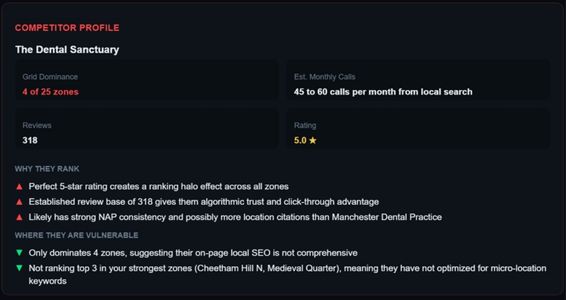
The Dental Sanctuary holds the #1 ranking in 4 of 25 grid locations, including Higher Broughton, Lower Broughton, and Green Quarter — zones where Manchester Dental Practice ranks 5th to 17th. Their profile shows 318 reviews at a 5.0-star rating.
For local SEO in a dental context, a 5-star rating at that review volume creates what’s sometimes called a “ranking halo” — Google’s algorithm treats sustained review quality as a proxy for business legitimacy, which reinforces rankings across adjacent zones even where the competitor doesn’t have obvious geographic advantage.
The Dental Sanctuary is not untouchable. They dominate only 4 of 25 zones, which means their on-page local SEO is not comprehensive. They are not ranking top 3 in Cheetham Hill North or Medieval Quarter — the zones where Manchester Dental Practice is strongest. Their gaps are real and exploitable with the right content and citation strategy.
But the review differential matters. The gap between the two practices in review volume is where the ranking floor difference comes from.
Why This Pattern Is Common in Dental Practice Local SEO
Dentists face a specific problem in Google Maps that most other local businesses don’t encounter at the same scale: category saturation.
“Dentist near me” is one of the highest-competition local search terms in any UK city. Unlike a niche trade — a specific type of roofer or a specialist solicitor — every practice in the city is competing for the same term. There’s no long-tail escape route. Patients search “dentist near me” and expect Google to show them the closest, most trusted option.
In that environment, three factors decide who appears in the top 3:
1. Proximity to the searcher’s location. You cannot change where your practice is. But you can influence how Google understands your service area through profile configuration and citation consistency.
2. Review volume and recency. Google weights both. A practice with 300 reviews from the last 12 months outperforms a practice with 300 reviews from 3 years ago. Recency signals that the practice is active and that patients are satisfied now.
3. On-page local signals. Location-specific landing pages, Google Business Profile completeness, suburb mentions in content, and NAP (name, address, phone) consistency across directories.
The Manchester scan shows a practice that is likely weak on at least two of these three. The proximity wall pattern — ranking better at distance than nearby — specifically suggests a GBP configuration issue. Either the service area isn’t set correctly, or the practice’s geocoded address is pulling it into a different local cluster than where its actual patient base lives.
What the AI Fix Report Identified
GeoRankLand’s AI Fix Report analysed the scan data and returned five priority actions. These are based on the actual grid data, not generic dental SEO advice.
1. Audit Google Business Profile location settings and service area.
The inverted proximity wall is the clearest indicator of a GBP geocoding or service radius problem. Verifying the practice address is correctly pinned and that the service area explicitly includes Broughton Park, Collyhurst, and the Blackfriars zones is the highest-priority fix.
2. Add location-specific landing pages for Blackfriars NW, Cheetham Hill North, and Higher Broughton.
Each page should target the zone name alongside “dentist near me” and include neighbourhood-specific content — not boilerplate copy with suburb names swapped in. Google can distinguish between thin location pages and genuine neighbourhood content.
3. Review citation consistency across local directories.
Citation inconsistency — where the practice name, address, or phone number appears differently across Yell, Yelp, Healthgrades, and other directories — directly suppresses rankings in the affected zones. Castlefield and Brunswick SE are the priority audit targets based on where the blackout zones sit.
4. Conduct an on-page SEO audit for keyword density and suburb mentions.
The practice website should reference multiple suburbs from the scan area naturally in service page content. Pages that only mention “Manchester” without suburb specificity don’t signal local relevance to Google at the neighbourhood level.
5. Increase review volume through patient request campaigns.
The review gap relative to The Dental Sanctuary is costing visibility across at least 5 zones. Closing from 302 to 380 reviews within 90 days — through post-appointment text requests and a printed QR card at the front desk — is achievable and would meaningfully shift the ranking floor in the mid-strength zones.
The Territory Strategy: Where to Start
The Competitive Intelligence report identified a clear sequence for this practice. It applies to most dental practices in a similar position.
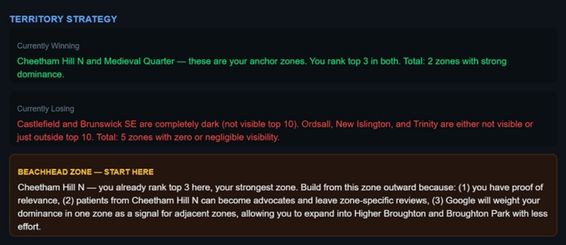
Anchor zones first.
Cheetham Hill North and Medieval Quarter are where this practice already ranks top 3. The immediate priority is locking those positions in with dedicated landing pages and zone-specific review requests. Rankings at position 3 can slip to position 4 or 5 without active reinforcement — especially in high-competition dental markets.
Adjacent zones second.
Higher Broughton and Broughton Park sit geographically next to Cheetham Hill North. Google treats geographic proximity between zones as a relevance signal — dominance in one zone creates ranking momentum in adjacent ones. These are the lowest-effort expansion targets.
Dark zones last.
Castlefield, Brunswick SE, and Old Trafford require more intensive intervention — zone-specific landing pages, targeted citation building, and potentially Google Posts naming these areas explicitly. These aren’t quick wins, but they represent the largest untapped patient pool.
The 90-day sprint plan in the Competitive Intelligence report takes this sequence and assigns it week by week, with expected ranking outcomes at each stage.
What This Means for Your Dental Practice
If you’re running a dental practice in a UK city and haven’t mapped your rankings across your full service area, this data is what you’re probably missing.
Your average rank — whatever your current tool reports — is a single number generated from a single location. It tells you almost nothing about what patients in Salford, or Chorlton, or wherever your outer catchment sits, are actually seeing when they search “dentist near me.”
The proximity wall finding is particularly important. If your rankings are stronger at distance than nearby, that’s not a general SEO problem. That’s a specific GBP configuration issue with a specific fix. Without the geo-grid data, you’d never know it exists.
The Competitive Intelligence report goes a level deeper — it identifies which competitors hold #1 positions in each of your weak zones, what’s driving their rankings, and where they’re specifically vulnerable. For a dental practice trying to reclaim visibility in 5 or 10 lost zones, knowing which competitor to target in each zone changes the strategy significantly.
The Practical Step
Run a geo-grid scan for your own practice, or for your dental client, using “dentist near me” as the keyword.
Look at the heatmap before you look at any aggregate number. Where is the practice invisible? Where does it rank top 3? Is the pattern consistent — strong near the practice address, weaker further out — or is it inverted like the Manchester example?
The answer tells you which of the three ranking factors to fix first.
A single scan takes 30 seconds. The AI Fix Report generates automatically from the data. If you want the full Competitive Intelligence breakdown — competitor profiles, zone-by-zone #1 holder analysis, and a 90-day sprint plan — that’s available for any scan.
Run a free scan at georankland.com